Capabilities are the new black. As digital transformation becomes standard, innovation is more critical for…
Why Volatility Is Now the Default Operating Model


- Workforce volatility is now the permanent operating model, forcing enterprises to rethink talent development, leadership strategy, and workforce agility at scale
- Accelerating AI adoption and shrinking skills half-life are widening enterprise skills gaps, making traditional upskilling and reskilling programs too slow to compete
- Centralized, completion-based learning models cannot keep pace with quarterly strategy pivots, organizational restructuring, and digital transformation
- Competitive advantage now depends on capability speed: the rate at which organizations can build, apply, and scale critical skills across distributed teams
- High-performing organizations embed AI upskilling, peer mentoring, and practice-based learning directly into the flow of work to drive measurable business impact
The defining challenge of 2026 isn’t any single disruption. It’s sustained volatility.
What organizations once treated as temporary turbulence has become the permanent operating environment. Economic uncertainty, workforce contraction, accelerating skills obsolescence, regulatory pressure, and the rapid adoption of AI are forcing enterprises to fundamentally rethink how they develop talent, build leadership, and create organizational capability at scale.
For enterprise talent development leaders, the implications are profound. The old playbook — built for stability and incremental improvement — no longer works. Instead, they’re being asked to mobilize tens or hundreds of thousands of employees to adapt continuously, exercise judgment closer to the work, and take on broader leadership responsibility. All while working with smaller teams, fewer managers, less centralized support, and diminishing tolerance for slow, rigid programs.
The Evidence: Volatility Across Every Dimension
The numbers paint a stark picture. According to the World Economic Forum’s Future of Jobs Report 2025, job disruption will affect 22% of all jobs by 2030, with 170 million new roles created and 92 million displaced. More critically, employers expect 39% of workers’ core skills to change in that same timeframe — and 63% of employers already cite skills gaps as the primary barrier to business transformation.
To illustrate this seismic shift in modern workplaces, let’s take a look at an all-too-common scenario faced by today’s multidimensional teams:
7:45am — The Slack Message Nobody Expected: Marcus, a Marketing Ops Manager at a 4,000-person SaaS company, opens his laptop to find a company-wide announcement: the demand gen team is being folded into a new “AI-led growth” function. His team of six is now three. He has a 1:1 with his remaining analyst, Priya, in 45 minutes — and she already knows.
This is the “forever layoff” in action. No single dramatic downsizing, just a quiet halving of the team with a strategy pivot attached.
8:30am — The Skills Gap Becomes Personal: Priya is sharp, but her expertise is in Salesforce reporting and manual campaign attribution — skills that took her three years to build. The new AI-led growth stack the company just purchased doesn’t use Salesforce the same way. Marcus checks the internal L&D portal. There’s a course on the new platform… currently being developed. ETA: Q3.
It’s February. Priya needs to be functional in six weeks, when the new fiscal quarter kicks off and leadership expects the new system to be producing insights.
10am — The Workaround Nobody Planned For: Marcus spends an hour on LinkedIn and internal Slack channels hunting for someone in the company who actually knows the new platform. He finds one person — in the London office, a different time zone, technically in a different business unit. He cold-messages her. She’s willing to help but has no formal capacity to do so; it’s not in her job description.
This is distributed capability building happening by accident rather than by design. It works today, but it’s entirely dependent on Marcus’s hustle and a stranger’s goodwill.
1pm — The Metrics Trap: Marcus’s VP asks for a progress update on the team’s transition. The only thing the system can track right now is course completion. Priya has completed two modules of an introductory AI literacy course — neither of which is relevant to her actual job. On paper, the team is “in training.” In reality, they’re three weeks behind on a campaign that needs to launch.
3:30pm — A Real Moment of Progress, Barely Visible: The London contact does a 45-minute Zoom with Priya. It’s ad hoc, undocumented, and incredibly useful. Priya gets hands-on with the actual tool on a real data set. By 5pm she’s produced a rough version of the attribution report that used to take her a full day in under two hours.
Marcus has no way to log this in any system. There’s no record of the mentoring, no capture of what Priya learned, and no way for L&D to know this peer exchange was ten times more effective than the course she’s technically “in.”
5:15pm — The Quiet Cost Marcus closes his laptop having spent roughly 40% of his day managing the organizational consequences of volatility rather than doing his actual job. Priya is less anxious than she was at 8:30am, but she’s also aware that in 18 months, this cycle will likely repeat.
What This Shift Illustrates
This scenario’s core tension is real: The organization’s formal systems (development portal, course catalog, completion tracking) operated on a timeline completely disconnected from the business’s actual pace of change. The actual capability building that happened was informal, fragile, and invisible to leadership.
The difference between organizations that thrive and those that don’t isn’t whether Marcus exists — it’s whether the company has built infrastructure that makes what Marcus did by instinct repeatable, visible, and scalable across hundreds of managers simultaneously.
Bottom line: This isn’t about isolated skill updates. Boston Consulting Group research shows the half-life of skills has collapsed from 10-15 years to less than five years — and in technical fields, to as little as two years. What this means in practice: By the time traditional training programs are designed, approved, and rolled out, the skills they’re teaching may already be obsolete.
The pressure compounds across multiple fronts:
• Economic volatility: Budget whiplash, hiring freezes followed by urgent rehiring, and relentless pressure to “do more with less” mean reskilling must happen faster than long, fixed programs can deliver.
• Workforce volatility: According to Glassdoor’s 2026 Worklife Trends report, small, rolling layoffs (the “forever layoff”) have become the norm, rising from 38% of all layoffs in 2015 to 51% in 2025. This creates ongoing anxiety and knowledge loss while placing greater strain on remaining employees.
• Technology acceleration: AI went from the sixth most scarce technology skill to number one in just 16 months. Yet according to IMD research, only 25% of workers receive formal AI training from their employers, despite workers reporting they save two hours per day using these tools.
• Organizational churn: Reorganizations, mergers, acquisitions, and strategy pivots are happening more frequently, making continuity and change-readiness critical capabilities rather than nice-to-haves.
Why Traditional Approaches Fall Short
Most talent development strategies were built for a different world, one where change was episodic, skills had longer shelf lives, and organizations had time to plan. The typical playbook involved launching a program, rolling it out broadly, measuring completion, and moving on.
That model breaks in volatile conditions for several reasons:
• Speed mismatch: Development cycles of 6-12 months can’t keep pace with changes happening quarterly or even monthly.
• Centralization bottleneck: Small teams handling workplace development are unable to design, customize, and deliver learning or mentoring fast enough to meet the needs of tens of thousands of employees across diverse roles and geographies.
• Shallow engagement: As SHRM’s 2026 Top Workplace Issues highlights, nearly 70% of organizations report difficulty filling positions due to skills gaps. Generic training doesn’t build the applied capability needed to fill those gaps — it simply checks a compliance box.
• Disconnection from work: Traditional programs often treat learning and coaching as something separate from doing. In a volatile world, that separation is fatal. People need to learn in context, apply immediately, and iterate rapidly.
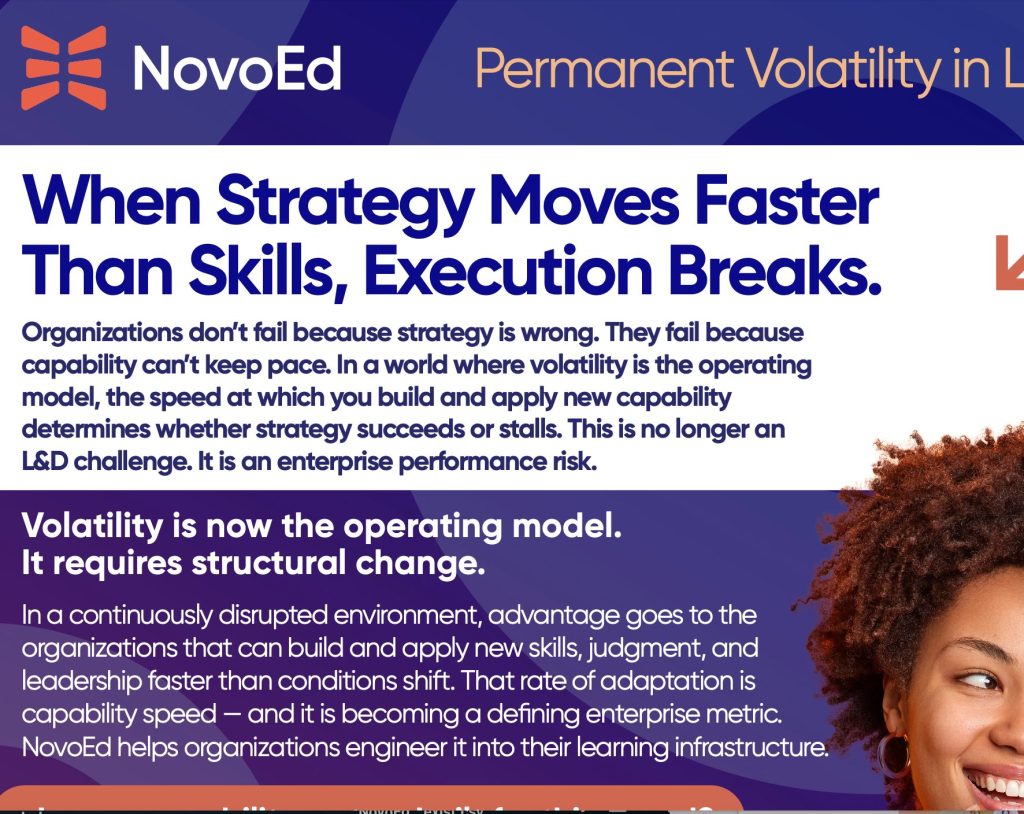
A Different Operating Model: Defining Competitive Advantage Through Capability Speed
Organizations that are thriving in volatility aren’t abandoning talent development; they’re fundamentally redesigning how capability gets built and how quickly. The shift is from centralized control to distributed orchestration: setting clear direction and standards at the top while enabling leaders, managers, and teams throughout the organization to develop judgment, skills, and leadership at scale and in the flow of work.
This isn’t about losing control. It’s about recognizing that in a world where managers influence 70% of employee engagement yet are under unprecedented strain, capability building must happen closer to the work — not in centralized programs that require months to deploy. In today’s relentlessly volatile environments, the defining competitive advantage is capability speed: the rate at which an organization can build and apply new skills at scale. Agility, adaptability, acuity: these are the three A’s that matter most to staying competitive today.
What does this look like in practice?
• Applied, practice-based learning: Instead of abstract courses, employees work on real challenges with structured practice, coaching, and feedback loops that build both competence and confidence.
• Mentoring and peer learning at scale: Distributed models leverage the expertise that exists throughout the organization, enabling knowledge transfer and leadership development without relying solely on formal programs or shrinking L&D teams.
• Manager enablement as a force multiplier: Equipping managers to coach, develop, and guide their teams means capability building happens continuously, not in discrete events.
• Rapid iteration and deployment: Rather than waiting for perfect, comprehensive programs, organizations launch capability sprints — short, high-frequency initiatives that can adapt as conditions change.
• Evidence and visibility: Executives and governance stakeholders need proof that learning translates to capability. That means tracking not just completion rates, but time-to-productivity, quality improvements, and business impact.
The Strategic Imperative
The Randstad Workmonitor 2026 makes clear what’s at stake: “Without a workforce that is aligned, productive, and adopting AI at speed, the business optimism for 2026 will not materialize.” Trust in leadership is declining, with 72% of workers relying on strengthened relationships with managers to navigate economic uncertainty.
This is the new reality: Volatility is the baseline, not the exception. Organizations can’t wait for conditions to stabilize. They can’t rely on annual training plans that assume predictable skill demands. They can’t afford to limit leadership development and mentoring to a small group of people. And they can’t expect small L&D teams to build and deliver everything centrally.
What they can do is build systems that treat capability development as ongoing, distributed, and embedded in the work itself. This means investing in platforms and processes that enable learning, mentoring, and practice at scale — without requiring linear expansion of central resources.
The organizations that perform best in this environment are those that stop trying to control change and start orchestrating capability in response to it. They set clear intent and standards, provide the infrastructure for distributed learning, and empower people throughout the organization to build the judgment and skills they need to adapt.
Preparing for Permanent Volatility
The question isn’t whether your organization will face ongoing disruption. It’s whether you’re building the capability to thrive through it.
As the World Economic Forum notes, technology will transform 1.1 billion jobs in the next decade. That’s not a one-time event requiring a single reskilling wave. It’s a permanent acceleration that demands fundamentally different approaches to talent development.
Volatility is now the default operating model. The winners won’t be the organizations that predict the future perfectly — they’ll be the ones that build workforces capable of adapting faster than change itself. And those that don’t? They face unmitigated competitive loss that is daunting to earn back: Execution, innovation, AI adoption, employee morale, revenue velocity, leadership succession, and more are all threatened and ultimately compromised.
Distributed capability building only works when learning, mentoring, and practice are coordinated through shared infrastructure, otherwise the effort fragments again. That’s why organizations are rethinking not just programs, but the systems that enable them. At NovoEd, we believe that when stability is no longer guaranteed, your ability to build capability at scale is your only true security. Contact us to learn more and schedule your demo today.


